Digitization is driving up the demands on the IT infrastructure. Higher bandwidths, stricter security requirements and exploding energy costs are confronting IT managers with a fundamental decision: Do I continue to expand my own data center (on-premises), do I go completely into the public cloud (AWS/Azure) or do I choose the middle ground?
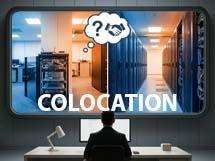
This is where colocation (often called server housing) comes into play. It’s the answer for companies that want to maintain full control over their hardware, but want to leave the operation of the physical building envelope to professionals. In this article, we clarify when it is worth moving to an external data center and what you need to look out for when choosing a provider.
What exactly is colocation?
With the colocation model, you don’t rent servers (like hosting), but “floor space”. You bring your own hardware – servers, storage, firewalls – to a professional data center.
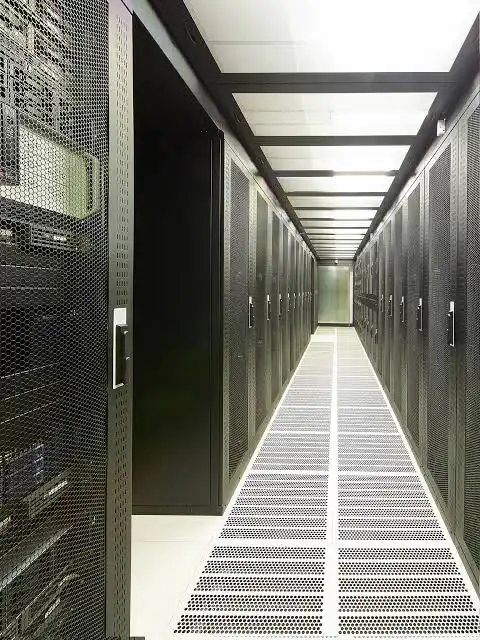
The provider provides the infrastructure (facility):
- Racks (partial racks, full racks or entire cages)
- Power Supply & UPS
- Air conditioning
- Physical Security
- Internet Uplinks (Connectivity)
The decisive difference to the cloud: It’s your sheet metal. You determine the hardware specs, you configure the hypervisor, you have sole data sovereignty.
Benefits of Colocation
Why should you give up your hardware? In most cases, it is physical limits in one’s own office building or cost factors.
Cost Savings & CAPEX vs. OPEX
Building your own data center that meets modern standards (Tier 3) costs millions. Colocation transforms these high capital costs (CAPEX) into predictable operating costs (OPEX). In addition, providers benefit from economies of scale when purchasing electricity, which often has a positive effect on operating costs.
2. Scalability without conversion
If your server room is full, it’s full. In a colocation data center, you can grow flexibly: from a single height unit (U) to an entire rack to private “cages”. Do you need 10 kW more power for an HPC cluster in the short term? In the Colo data center, this is usually just a call, not a new power line.
Physical Security & Certifications
Hand on heart: How secure is your server room in the basement? Professional data center operators offer security standards that are difficult to represent internally:
- 24/7 security & video surveillance.
- Biometric access controls & separation gates.
- Certifications according to ISO 27001 (information security) or EN 50600.
High Availability (Power & Cooling)
Power outages are poison for uptime. Colocation centers use redundant A/B feeds, UPS (Uninterruptible Power Supply) systems, and diesel generators that bridge even longer blackouts. The air conditioning is also redundant to avoid hotspots.
Connectivity & Carrier Neutrality
Carrier neutrality is a huge advantage. You are not tied to the one provider who happened to have developed your office building. In the data center you have access to various carriers and Internet Exchange Points (such as DE-CIX). This guarantees low latencies and redundant connections.
Colocation vs. Cloud vs. On-Premises
What is the “sweet spot” for colocation? Here is the direct comparison:
| Feature | On-Premises (Server Room) | Colocation (Housing) | Public Cloud (IaaS) |
| Hardware Ownership | Yes (You Buy) | Yes (You Buy) | No (You Rent Resources) |
| Control | 100% (Hardware & Buildings) | High (Hardware) | Medium (OS/Application Only) |
| Investment | High (Building, Air Conditioning, Hardware) | Medium (Hardware Only) | Low (Pay-as-you-go) |
| Scalability | Difficult (Structural Limits) | Good (Bookable) | Excellent (Elastic) |
| Connectivity | Mostly limited (1-2 ISPs) | Excellent (Carrier Neutral) | Excellent (Backbone) |
Checklist: Finding the right provider
Not every data center fits every company. When choosing, pay attention to these criteria:
- Location & Latency: Is the data center close enough so that you can drive there yourself in an emergency (“remote hands” are not enough)? Is it geographically convenient for your users?
- Animal classification: A Tier-3 data center (or equivalent) provides redundant components and paths. Tier-1 or Tier-2 are often not sufficient for critical business applications.
- Certifications: Essential for industries such as finance or healthcare: Are ISO 27001, ISO 9001 or PCI-DSS available?
- Service Level Agreements (SLAs): What does the provider guarantee in terms of electricity and air conditioning? 99.99% or more is common.
- Connectivity: Are there direct connections (on-ramps) to hyperscalers such as AWS or Azure? This is important for hybrid strategies.
Conclusion: Is Colocation Worth It?
Is colocation worth it? Yes, if you need control but don’t want to be a data center operator. For many companies, colocation is the stable foundation of a hybrid strategy: The sensitive core systems and legacy databases run on their own hardware in the colocation rack (data protection, performance), while web frontends and scalable workloads are outsourced to the public cloud.
Colocation is worthwhile for you if:
- You have specific hardware requirements that the cloud doesn’t map.
- You have regulatory requirements to know exactly where your data is.
- Your own server room is bursting at the seams or is too insecure.
further links
| Uptime Institute: Tier Classification System The global reference for data center classification (Tier I to IV). Important for understanding reliability. | https://uptimeinstitute.com/tiers |
| BSI IT-Grundschutz: Module INF.2 Data Center BSI requirements for the secure operation of data centers and for the selection of service providers. | https://www.bsi.bund.de/SharedDocs/Downloads/DE/BSI/Grundschutz/IT-GS-Kompendium_Einzel_PDFs_2022/10_INF_Infrastruktur/INF_2_Rechenzentrum_sowie_Serverraum_Edition_2022.pdf |
| EN-CIX: What is an Internet Exchange Point? Explanation of the world’s leading Internet exchange in Frankfurt why direct connections (peering) reduce latencies. | https://www.de-cix.net/de/bibliothek/faqs |
| Bitkom: Data Center Guide Information from the industry association on energy efficiency and security in German data centers. | https://www.bitkom.org/Themen/Digitale-Souveraenitaet-Infrastruktur-Regulierung/Rechenzentren-IT-Infrastruktur |





Be the first to comment