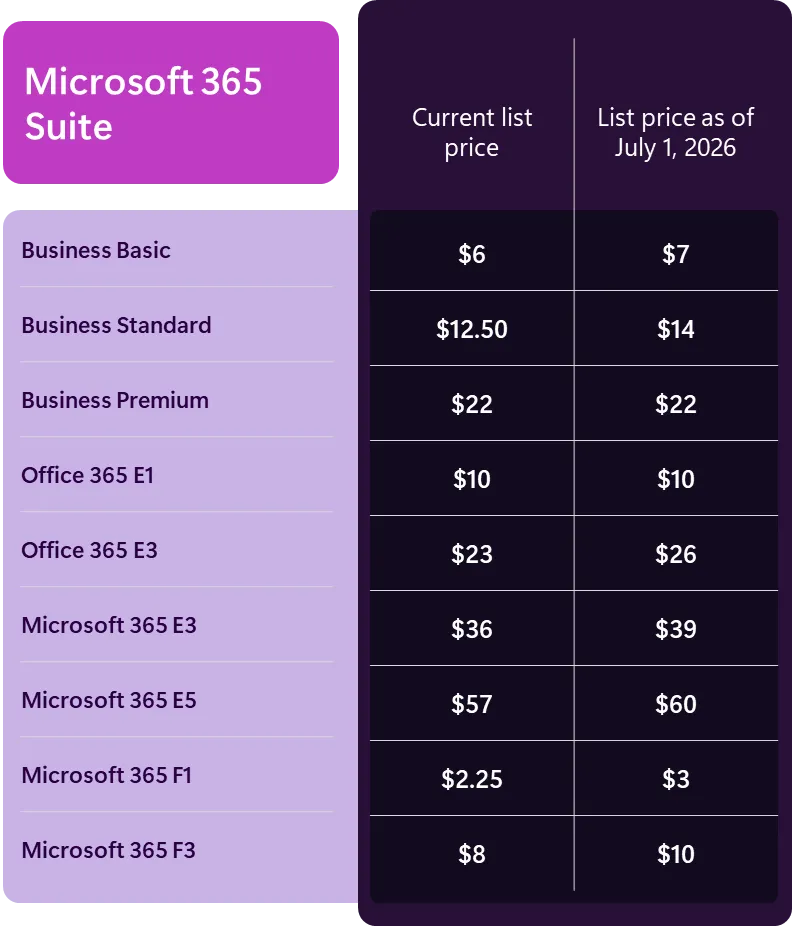
Anyone who looks at Microsoft invoices today and compares them with 2021 often rubs their eyes in amazement. For more than a decade, Microsoft knew only one direction when it came to cloud prices: sideways. But since 2022, we have been experiencing a real "staircase effect".
We have analyzed the price development of the two main plans, Microsoft 365 E3 and Microsoft 365 Business Premium, and take a look at what awaits us in the summer of 2026.
The review: A decade of calm, three years of storm
The history of Microsoft 365 pricing in Germany can be divided into three phases:
- The golden era (2011–2021): After the launch of Office 365 in Germany, prices remained almost static. An E3 plan cost around €19.70, Business Premium (since 2017) around €16.90. Microsoft added features like Teams without increasing the price.
- The double blow (2022–2023): In March 2022, Microsoft introduced the "New Commerce Experience" (NCE), which effectively meant a price increase of about 15-20% for many customers (especially with monthly flexibility). Just one year later, in April 2023, "currency harmonization" followed: a flat surcharge of 11% on euro prices.
- The structural change (2024–2025): The unbundling of teams (EEA/antitrust proceedings) has made prices more opaque. New packages without teams seem cheaper, but are often more expensive in the "re-bundle" (license + teams separately) than the old complete packages.
The numbers: This is how expensive the workplace has become
Here you can see the development of the net list prices (approx.) for annual subscriptions in direct comparison.
| Date / Event | Bus. Basic | Bus. Standard | Bus. Premium 👑 | Microsoft 365 E3 | Microsoft 365 E5 |
| 2011 – 2021 (phase of stability) | 4,20 € | 10,50 € | €16.90 | €31.50 | 53,70 € |
| March 2022 (NCE Global Update) | 5,10 € | 10,50 € | €18.60 | €35.40 | 53,70 € |
| April 2023 (Currency Adjustment) | 5,60 € | 11,70 € | 20,60 € | €37.70 | 59,70 € |
| 31 Dec 2025 (Status Quo) | 5,60 € | 11,70 € | 20,60 € | €37.70 | 59,70 € |
| 01. July 2026 | ~ 6,55 € 🔺 | ~ 13,10 € 🔺 | 20,60 € | ~ 40,80 € 🔺 | ~ 62,80 € 🔺 |
| Increase (July 2026) | approx. +17 % | approx. +12 % | 0 % | approx. +8 % | approx. +5 % |
All prices are net list prices per user/month in the annual subscription (NCE Annual Commit). Note on M365 E3/E5: Pricing is based on the "with Teams" version (Legacy/Enterprise). New licenses in the EEA (without Teams) are cheaper, but often priced the same or more expensive in a bundle with a separate Teams license.
Analysis of the numbers:
- The "Business Premium" anomaly: The most important message is what doesn't happen. Microsoft is leaving the price of Business Premium stable (0% increase). This shrinks the price gap to "Business Standard" to a historically low ~€7.50. Microsoft is thus making the premium plan the de facto standard and punishing all those who stay on the smaller packages.
- Business Basic & Standard (The Losers): If you want to stay "small", you pay more. Business Basic customers are hit hardest with around +17%, standard customers have to swallow about +12%.
- Microsoft 365 E3: Here, too, Microsoft is turning the price screw (+8%). The gap to Business Premium thus grows to over €20 per user/month . For companies with less than 300 employees, there will be almost no rational argument for E3 from July 2026.
The outlook: 01.07.2026
While we end the year 2025 relatively stable, big events are casting their shadows ahead. According to current information and market observations, the next wave of adjustments is imminent.
Cut-off date 1 July 2026: Microsoft is preparing the market for a further price adjustment. The reasons for this are manifold:
- AI Infrastructure Cost: The massive expansion of data centers for co-pilot and AI services must be refinanced.
- Inflation & Energy: The operating costs of cloud infrastructure have risen worldwide.

What does this mean for admins? Unlike the 2023 flat-rate currency adjustment, this time certain packages will be hit harder than others.
According to reports (see Heise), surcharges of up to 33% are possible, especially in the Business Basic area and for monthly terms.
For the 2026/2027 budget planning, you should therefore no longer expect the usual 5% buffer, but rather a 15-33% buffer to be on the safe side.
Conclusion: License Management
The days when you bought licenses once and forgot about the price for 10 years are over. The costs per user are increasing, but the range of functions (security, AI) is also growing.
Our tips for 2026:
- Check NCE runtimes: If contracts are renewed before 01.07.2026, you will secure the "old" price for another 12 months (Price Protection).
- Tidying up: Does the company still pay for users who have long since left? Regular audits of active user accounts are mandatory.
- Downgrade Options: Does every user really need an E3? Often an F3 plan (note: web apps only) or switching to Business Standard is sufficient for "Frontline Worker".
| M365 Plans Comparison Site (Microsoft Docs | )https://learn.microsoft.com/de-de/office365/servicedescriptions/office-365-platform-service-description/office-365-plan-options |
| PhinIT.DE article | https://phinit.de/2025/12/06/microsoft-365-preiserhoehung-ab-juli-2026-deutlich-teurer/ |

Sei der Erste und starte die Diskussion mit einem hilfreichen Beitrag.
Leave a comment
Dein Beitrag wird vor der Veröffentlichung kurz geprüft — fachlich, respektvoll und auf den Punkt ist hier genau richtig.