
... and custom providers (CYOT) will be available from October 30th!
Microsoft is discontinuing its own delivery of SMS and voice calls for MFA in Entra ID. Organizations that still require phone-based methods will need to select an external telephony provider in the future.
According to Message Center MC1519855, the option "Choose Your Own Telephony Provider" (CYOT) will be generally available worldwide on October 30, 2026.
- September 2026: Passkeys become the standard. Users with SMS or voice configured in the Authentication Methods Policy or legacy MFA settings will be automatically enabled for passkeys and prompted to register during MFA login. Users may defer the prompt as often as needed until the deadlines.
- October 2026 – CURRENT: CYOT is generally available.
- February 2027: Microsoft delivery ends for all users except Global Administrators and external users. Internal guest users are included.
- July 2027: Delivery also ends for Global Administrators and external users.
What happens next
Users whose only available MFA method is SMS or voice must register a passkey at login after the respective deadline. The prompt blocks the login until a telephony provider is configured and cannot be disabled. Those who already have a passkey, Windows Hello for Business, or another phishing-resistant method are unaffected.
A temporary opt-out from September 1, 2026, to February 1, 2027, only delays the automatic passkey activation and registration campaign, not enforcement. It is managed via the Graph property `optOutSettings.passkeyDynamicMigration` on the Authentication Methods Policy (Beta endpoint, permission `Policy.ReadWrite.AuthenticationMethod`).
What You Can Do Now
First, you need the list of affected users. Microsoft provides the PowerShell script Get-SmsVoicePolicyUsers.ps1 on GitHub for this purpose. You will need the Global Reader, Authentication Policy Administrator, or Security Reader role to use it.
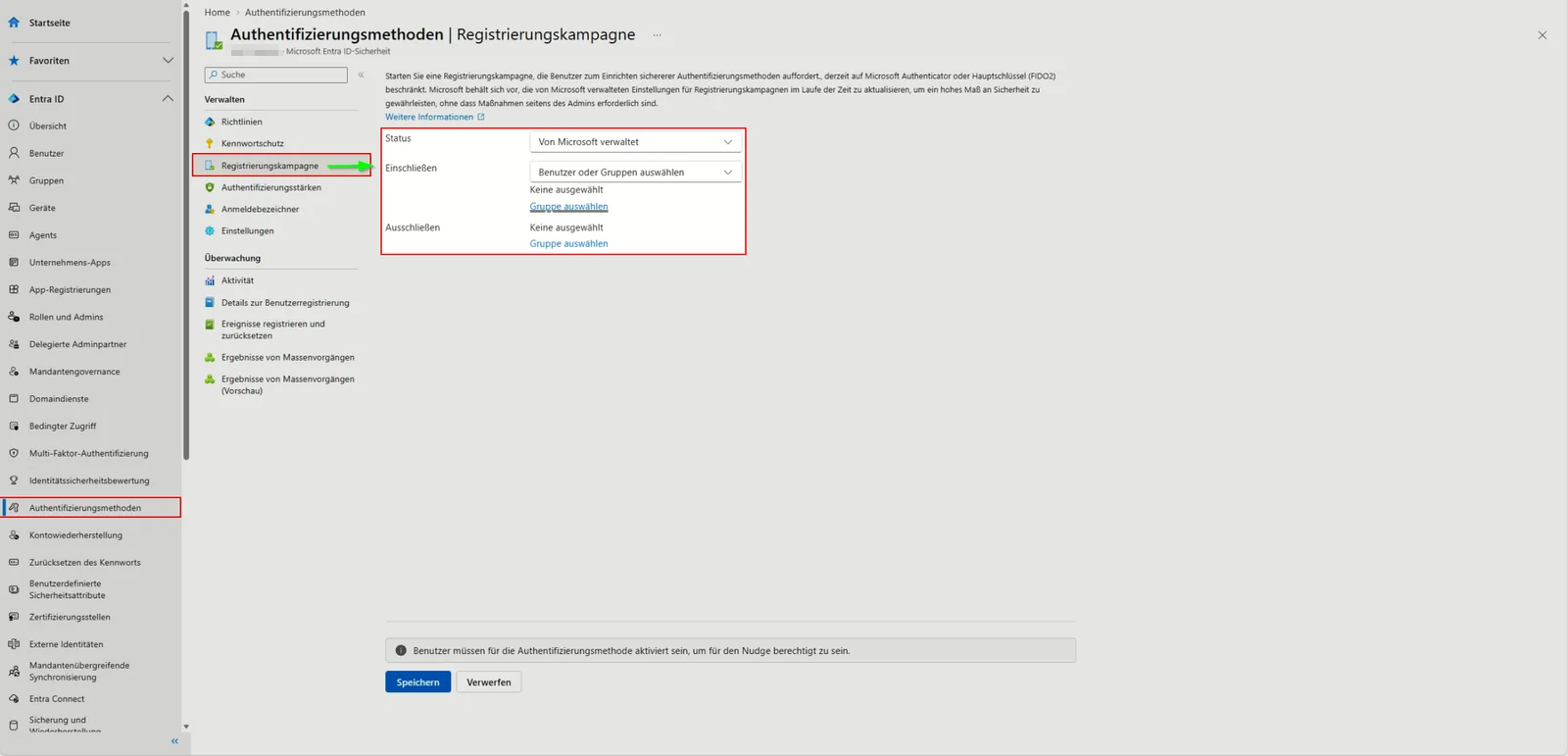
Next, you enable Passkey (FIDO2) as an authentication method and set up the registration campaign.
- In the Entra Admin Center, navigate to > Authentication methods > Registration campaign > Campaign state > to Microsoft managed.
As the target, you select the security group for SMS and voice users that you created after the identification via the script. This ensures the campaign reaches exactly those users who would later be blocked, and not the entire tenant.
CYOT is only worthwhile when there is a documented need, such as for regulatory reasons or for users who cannot use a passkey. The provider selection is made via the Microsoft Security Store. Soprano and Telesign are listed in the Private Preview, with more expected to follow at general availability. Contract, configuration, and monitoring remain your responsibility.
According to the Message Center, purchasing in the Security Store requires an Azure billing subscription, a resource group, and an appropriate Azure role. Microsoft will provide menu paths and roles for configuration with the documentation on October 30th—check them yourself at that time.
Conclusion
The shutdown is a deadline, not a suggestion. Those who use SMS and voice calls purely out of habit should switch to passkeys and save on provider costs. SMS is also not phishing-resistant, as SIM swapping and SS7 attacks bypass the channel.
If you need phone-based MFA for business reasons, you should start planning your vendor selection and procurement now—both take longer than the technical implementation.

💬 Comments
0 KommentareSei der Erste und starte die Diskussion mit einem hilfreichen Beitrag.
Leave a comment
Dein Beitrag wird vor der Veröffentlichung kurz geprüft — fachlich, respektvoll und auf den Punkt ist hier genau richtig.